
Drive an Albuquerque street in late afternoon and you can pick out the west-facing garages without trying. The doors are chalky. The trim is cooked on one side of the street and fine on the other. That same sun lands on the floor behind the door, and a coating that ambers by the threshold is one of the most common reasons somebody calls me about a floor that is only a few years old.
I have written about whether a coated garage floor survives Albuquerque sun and winter in general. This post is narrower. If your garage door faces west or southwest, here is exactly what I would put on your slab, and why.
What actually goes wrong
Ultraviolet light breaks down plastics, and epoxy resin is a plastic. Leave straight epoxy in direct sun and it ambers — a warm yellow cast that creeps in from the door and stops in a hard line right where the shade begins. It is not dirt and it does not wash off. In this town it is the signature of a bargain floor, and a west-facing bay puts it on display faster than anywhere else.
The part people miss is that the door spends time open. A garage with the door up at six in the evening is taking direct, unfiltered high-desert sun straight onto bare floor, at the hour when that sun is coming in almost horizontally and reaching the back wall.
The strip by the door is a different floor
Sun is only half of it. That first stretch of slab inside the door is where every other stress concentrates too. It is where snowmelt and grit get dragged in, where the wind blows dust, and where a car that has been rolling on hot summer asphalt parks nose-in and dumps tire heat into the concrete as it cools. If a floor is going to fail, it starts there. So that is the zone I build for.
What I put on a west-facing garage
The same system I put on every garage, with no shortcuts, because the topcoat is the whole answer. The slab gets 20-grit diamond grinding with dust extraction, so the coating is mechanically locked into open concrete instead of sitting on a sealed surface. Then a 100% solids cycloaliphatic epoxy body coat, a full flake broadcast, and a commercial-grade polyaspartic topcoat.
Polyaspartic is UV stable. It holds its color in sunlight, and it is hot-tire resistant, which matters enormously in the exact zone we just talked about. The epoxy that would amber is buried underneath doing structural work in a place the sun never reaches. That is the design: put each chemistry where it is strongest, and let the layer facing the sun be the one engineered for sun.
Color choices that are kinder to a sunny bay
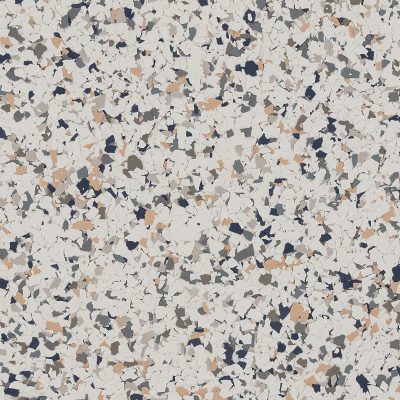
Two practical notes on color. First, a flake blend with real movement in it forgives a sunny garage better than a flat solid field does, because there is no single uniform tone for your eye to compare against. Second, a very dark solid floor in a west-facing bay gets genuinely hot underfoot in July, and it shows dust the moment the wind kicks up.
We carry 517 Torginol flake blends and 36 UV+ colors on our color page. When a space takes direct sun, the UV+ line is the one I point people toward first.
Two honest limits
First, our lifetime warranty applies to indoor concrete we prepare and install — garages, basements, workshops, indoor commercial floors. The driveway apron on the other side of that door is outdoor concrete living under different rules, and I am not going to pretend one promise stretches over both.
Second, no coating on earth undoes physics. What a properly built floor buys you is a surface that keeps its color and its bond through years of afternoons like ours, not immunity from the sun.
What to ask whoever else bids it
Ask one question: is the topcoat UV stable, and what is it called? Then ask what happens in the first few feet inside the door. Anyone who has actually coated west-facing garages in Albuquerque will answer both without pausing.
If you want to know how your bay would hold up, I will come look at the real slab. Call or text me at 505-352-4674 or send the free quote form — the quote is free and the advice is straight either way.