Somewhere along the way, epoxy versus polyaspartic turned into a sales pitch, with companies planting a flag on one side and trash-talking the other. I've installed more than 560 floors around Albuquerque, Santa Fe, and Rio Rancho, so let me tell you how I actually see it: these two materials aren't rivals. On a well-built floor, they're teammates.
What epoxy really is
Epoxy is a resin that cures into a hard, dense plastic and bonds tenaciously to properly prepared concrete. It builds thickness beautifully, which is exactly what you want in the body of a floor — it fills texture, carries decorative flake, and creates that thick, glassy foundation people picture when they imagine a coated garage. Its weaknesses are just as real: straight epoxy cures slowly, and sunlight will yellow it over time. Neither of those is a scandal. They're properties you design around.
What polyaspartic really is
Polyaspartic is a newer chemistry that cures fast, stays flexible enough to ride out temperature swings, shrugs off abrasion, and — this is the big one — holds its color in sunlight. It costs more as a material, and that fast cure makes it far less forgiving to apply, which is why it rewards installers who work with it constantly. Used as a topcoat, it is outstanding. And that is exactly how we use it.
Why we build floors with both
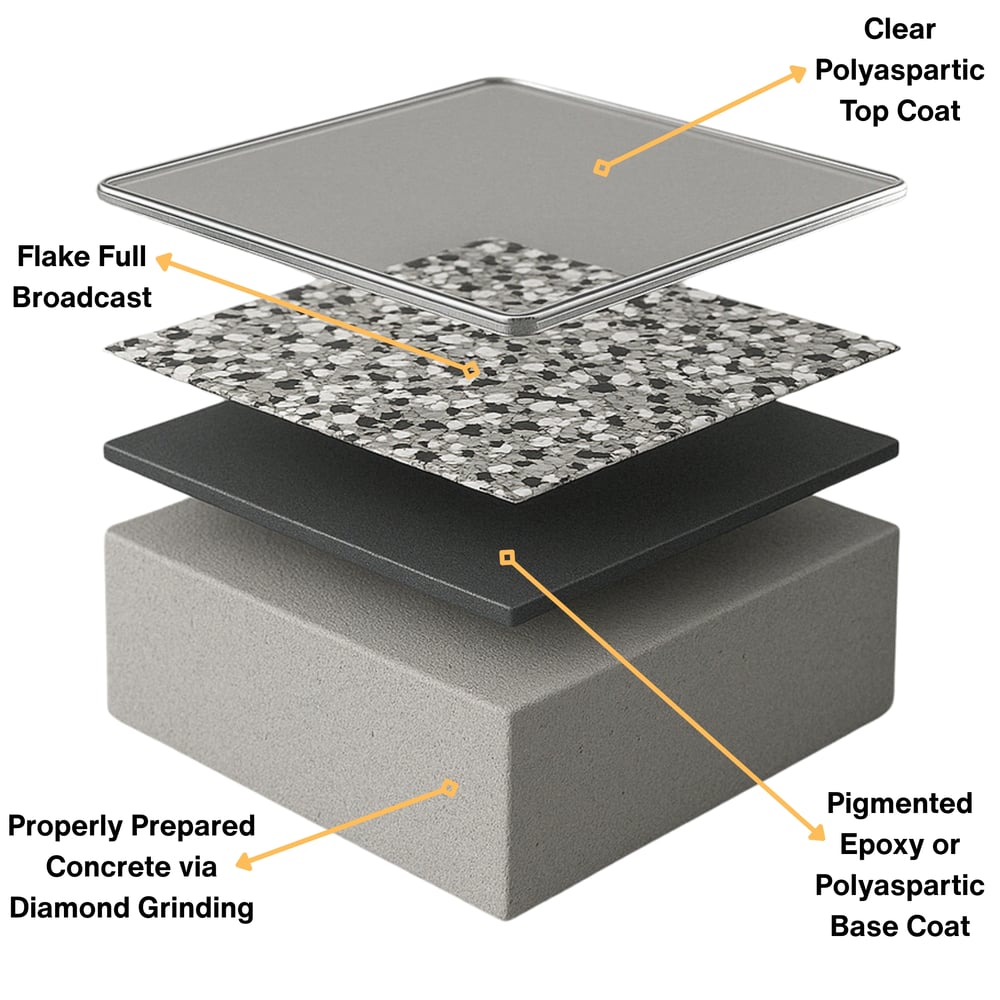
Here's the honest engineering: put each chemistry where it's strongest. The epoxy does the structural work down low, bonded into concrete that has been properly ground and repaired. The polyaspartic goes on top, where the sunlight, the hot tires, the dropped tools, and the road grime actually land. Polyaspartic topcoats are also a big part of how most of our residential installs are finished in one day — the topcoat cures fast enough that your garage comes back to you quickly instead of sitting taped off while the clock runs.
When someone tells you different
You'll meet companies selling all-polyaspartic systems as the only modern answer, and you'll meet bargain bids running cheap epoxy top to bottom. I won't claim every one of those floors fails. But when a coated floor does fail, there's usually a pattern, and it's rarely the brand of resin. An all-epoxy floor in a sun-washed garage will amber near the door. A rushed coat on badly prepped concrete will peel no matter whose name is on the bucket. The chemistry debate gets the attention, while the real difference is made — or lost — before any resin leaves the pail.
What to ask whoever bids your floor
You don't need to become a chemist to protect yourself. Ask a few plain questions of anyone quoting your garage. What is each layer of the system, by name? What prep is included — grinding, crack repair, moisture check — and what happens if the slab needs more of it? And is the topcoat UV stable? Listen for specifics. An installer who knows their system will answer without a pause, and an installer who answers every question with a brand name and a shrug is telling you something too.
The part that matters more than chemistry
Whatever goes in the bucket, the floor lives or dies on preparation. Grinding the slab open, repairing cracks, and getting the surface genuinely clean is most of the work and most of the outcome. It's also why I'm comfortable offering a lifetime warranty on indoor concrete we prepare and install — I know what's under our coatings, because we did the prep ourselves.
If you're weighing systems for your own garage, I'm happy to walk through it on your actual floor instead of a brochure. Call or text 505-352-4674 or use the free quote form and you'll get a straight recommendation, free, with zero obligation.