
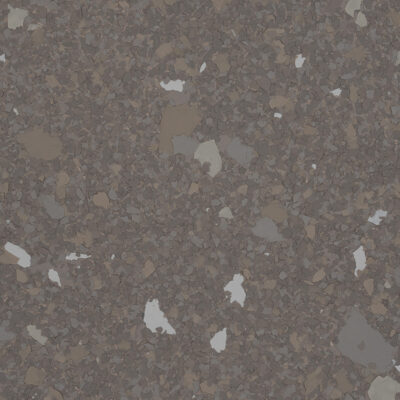
Once somebody has decided to coat their floor, this is usually the next fork in the road. Do you want the speckled look everybody recognizes, or a clean single color? It sounds like a purely cosmetic question. It is not, quite — the two floors are built differently and they age differently — so here is the honest comparison.
What each one actually is
A solid-color floor is a pigmented body coat with a clear topcoat over it. Smooth, uniform, and about as close to a painted-looking surface as a real coating system gets.
A flake floor adds a step. While the body coat is still wet, colored vinyl flake gets broadcast by hand until the surface is fully covered — a full broadcast, not a light dusting. Once it cures, the excess gets scraped and the whole thing gets locked down under the topcoat. The flake is not decoration floating on top. It is embedded in the system.
Hiding real life
This is the biggest practical difference and the reason most of my garage customers end up on flake. A solid color is a uniform field, and your eye reads every departure from it — dust, tire scuff, a dropped bolt, a chip, the dirt that blows in every time the wind comes up in the spring. A flake blend has variation designed into it, so all of that visual noise disappears into the pattern.
If your garage is a working garage, flake is kinder to you. If your floor is going to be swept and photographed, a solid color can be stunning.
Texture, and what it does not mean
A full flake broadcast gives the finished floor a little more surface texture than a slick solid coat. Do not translate that into safety. Our standard coatings are not slip-resistant, whether they are flake or solid, and an anti-slip additive is available as a paid upgrade. If the room gets wet — a patio, a kitchen, a bay where you wash vehicles — that upgrade is the right call, and flake alone is not a substitute for it.
Wear and repair
Both systems live or die on the same two things: how well the concrete was ground open before coating, and whether the topcoat can take what the room dishes out. We finish both with a commercial-grade polyaspartic topcoat over a 100% solids cycloaliphatic epoxy body coat, so neither one is being asked to survive on epoxy alone.
Where they differ is what damage looks like later. A gouge in a solid color is a hard-edged mark against a uniform field, and it is obvious. The same gouge in a flake floor reads as one more fleck. Neither is invisible, but one is a lot easier to live with.
Does it change the price?
Less than people expect. A flake broadcast is more material and another step of labor, so it is not free — but it sits inside the same working range. As of August 2026, garage floors run about $5 to $7 per square foot installed, and the bigger levers on where you land in that range are square footage and the condition of your slab, not the decorative choice. I walked through that math in epoxy cost by garage size.
What genuinely is free is which blend you pick. We carry 517 Torginol flake blends plus 36 UV+ colors, and the wild one costs the same as the safe one. All of them are on the color page.
When I steer people to solid
There are real cases. Some commercial and medical spaces want a uniform, easily inspected surface. Some showrooms want the floor to disappear so the product does the talking. Some people simply want one clean color and know exactly what they are asking for. That is a legitimate choice and I will build it properly.
When I steer people to flake
Working garages, shops, basements, anything that gets used hard by people who do not want to think about the floor again. It hides life. That is the whole argument.
And if the floor is one piece of a bigger plan — walls, lighting, cabinets, baseboards — it is worth choosing the blend alongside the rest of the room instead of in isolation. That is how our garage makeover projects get put together.
Still torn? Bring it to me. I will show you samples on your own slab, in your own light, which settles it faster than any website will. Call or text me at 505-352-4674 or send the free quote form — no charge and no pressure.