
People ask me about this more often than they ask about brands of resin. They have a garage floor they do not love, they have seen the snap-together tiles at the big-box store, they have seen roll-out mats online, and they want to know whether a coating is worth the difference. I install coatings for a living, so weigh my answer accordingly. But I have stood in a lot of garages across Albuquerque, Santa Fe, and Rio Rancho, and I can tell you honestly where each option actually wins.
Roll-out mats: the easiest thing you will ever install
A mat is a sheet of vinyl or rubber you unroll over your slab. It takes an afternoon, it hides the concrete instantly, and if you hate it you roll it back up. For a rental, a stopgap, or a spot under one workbench, that is genuinely hard to beat.
The problems start when it stays. A mat traps whatever ends up under it. Snowmelt, road brine, and the water that runs off your car after a monsoon storm all collect between the mat and the slab, and concrete cannot dry through vinyl. Just about every mat I have lifted in a garage that saw real use had a damp, dusty, sometimes rusty shadow underneath it. The mat also moves. You back in a little crooked, the edge buckles, and now it is a trip hazard and a place for grit to pile up.
Interlocking tiles: better, and still a surface sitting on a floor
Tiles are a real step up. Rigid plastic tiles snap together, they carry vehicle weight fine, they come in colors, and a determined homeowner can lay a two-car garage in a weekend. If you want something removable that still looks intentional, tiles are the best of the loose-lay options.
Look closely at what you are buying, though. A tiled floor is nothing but seams, and every seam is a route for dust, sand, and liquid to travel down. Once it is under there it does not come back up without pulling the floor apart. The same moisture problem applies. And tiles do nothing at all for the concrete itself. The cracks, the pitting, the spalled edge by the door are all still down there, just hidden. When you sell the house and somebody lifts a corner, the floor you paid to cover is exactly the floor you started with.
A coating is not a covering
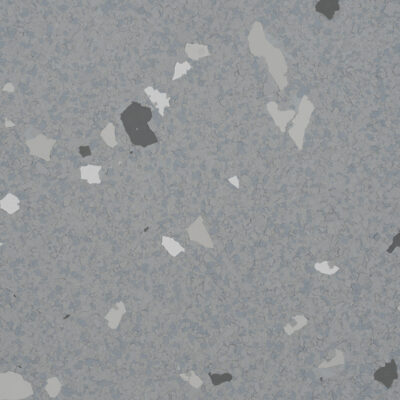
Here is the distinction that actually matters. Mats and tiles sit on top of concrete. A coating becomes part of it. We open the slab with 20-grit diamond grinding under dust extraction, repair what the grinder exposes, bond a 100% solids cycloaliphatic epoxy into that fresh profile, broadcast flake into it, and lock the whole thing down under a commercial-grade polyaspartic topcoat.
What you get is seamless. Nothing goes under it, because there is no under. You squeegee it or hose it and it is clean. It does not shift when you park, it does not curl at the edges, and the slab beneath it got repaired instead of concealed. It is also the only one of the three options that does anything for the concrete going forward, because sealed pores mean water is not soaking in and freezing on January nights.
The honest trade-offs
Coatings cost more up front. Our garage floors run about $5-7 per square foot installed, as of August 2026, and that number includes the prep, which is most of the labor and most of the outcome. You can price tiles and mats yourself in an afternoon, and on day one they will be cheaper. That is real and I am not going to pretend otherwise.
What the difference buys you is permanence, and a floor that is not a separate object you have to maintain. There is one trade-off running the other way, and I will name it: a coating is not reversible. If you want a different look in five years, you are grinding, not unsnapping. One more thing to be clear about, because it gets glossed over in a lot of sales pitches: a standard coating is not slip-resistant. If you want traction we add an anti-slip additive, and that is a paid upgrade you should ask for by name rather than assume.
What I would actually tell you
Renting, or honestly unsure how long you are staying? Buy a mat and spend nothing else. Want removable and tidy on a slab that is already in good shape? Tiles are fine, and I will tell you that for free. Planning to keep the house and tired of looking at the concrete? Coat it once, correctly, and stop thinking about it. Indoor concrete we prepare and install carries our lifetime warranty covering material defects and installation errors at 100%, which is a promise I can only make because we did the prep ourselves.
If you would rather have that comparison run against your actual slab than in the abstract, I will come do it. Call or text me at 505-352-4674 or send the free quote form. It is also worth reading what a real quote covers in what epoxy flooring costs in Albuquerque, and how the layers work in epoxy vs. polyaspartic. If it turns out tiles are the smarter buy for your situation, I will say so.