
I have already argued that epoxy and polyaspartic are not rivals. On a well-built floor they are teammates: epoxy builds the body, polyaspartic protects the surface. That is the general answer and I stand behind it.
But general answers are not what people are actually asking. They are standing in a specific room with a specific problem. So let me go room by room and tell you where each chemistry earns its keep.
The attached garage
This is the textbook case, and it is why the two-part build exists. The floor takes hot tires in July, road grit and snowmelt in January, and direct sun through an open door most of the year. Straight epoxy would amber where the light hits. A thin all-polyaspartic film would not build the thickness needed to carry a full flake broadcast well.
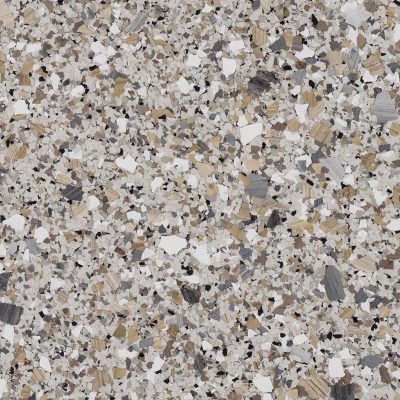
So the slab gets 20-grit diamond grinding with dust extraction, a 100% solids cycloaliphatic epoxy body coat, the flake, and a commercial-grade polyaspartic topcoat. The topcoat is UV stable and hot-tire resistant, and its fast cure is a big reason most residential garages are a one-day install.
The basement or the finished workshop
Downstairs the sun problem mostly disappears, and a different one takes its place: moisture from below. A basement slab is surrounded by soil on every side, and the coating has to survive vapor pushing up rather than light coming down. Here the epoxy body coat is doing the heavy lifting, and the topcoat is about abrasion and cleanability more than UV.
It is also the room where prep matters most, because you cannot see what is under a slab. That is a moisture conversation before it is a chemistry conversation.
The sunroom or the indoor patio
A room with a wall of south-facing glass behaves like an outdoor space with better manners. Plenty of UV, real temperature swing, and none of the water. This is where a UV-stable topcoat stops being a nicety, and where color choice matters — a floor that reads perfectly under garage light can look very different under all-day sun.
The actual outdoor patio
Outside is its own animal. Full unfiltered sun, big daily thermal swings, and moisture coming up through a slab poured on grade next to somebody's irrigation. UV stability is mandatory, and one more thing has to be said plainly: our standard coatings are not slip-resistant, and the anti-slip additive is a paid upgrade — one I recommend on any outdoor surface that gets wet with bare feet on it.
The warranty line also changes outside. Our lifetime warranty covers indoor concrete we prepare and install. A patio is outdoor concrete, and I will always tell you that before you sign anything, not after. There is more on that on our patios page.
The commercial kitchen
Here the honest answer is that neither one is the hero. A kitchen floor takes boiling water, caustic cleaners, and daily thermal shock, and that usually calls for urethane cement instead of a decorative epoxy system. The same slip rule applies with even more force: standard coatings are not slip-resistant, and in a wet kitchen the anti-slip upgrade is the one I recommend every time.
The showroom, the retail floor, the office
In a space where the floor is part of the product, appearance leads. Metallic epoxy, self-leveling epoxy, and quartz sand broadcast all live here, and the polyaspartic topcoat does the unglamorous work of surviving cart wheels, dropped inventory, and a mop every night without dulling. Our full commercial system list is on the commercial page.
The room nobody thinks about
One more: a slab where the goal is sealing rather than shine. Sealing a floor as part of a radon mitigation approach is a layered system with its own logic, and the question there is what the assembly does as a whole, not which resin sounds better in a brochure.
The through-line
Across every one of those rooms the deciding factor was the same, and it was never the resin. It was what the room does to a floor, and whether the concrete underneath got opened up properly before anything went on it. Chemistry gets the argument. Prep gets the outcome.
If you want a recommendation for your actual room instead of a general one, call or text me at 505-352-4674 or send the free quote form. I will come look, tell you what I would put down and why, and the visit costs nothing.